
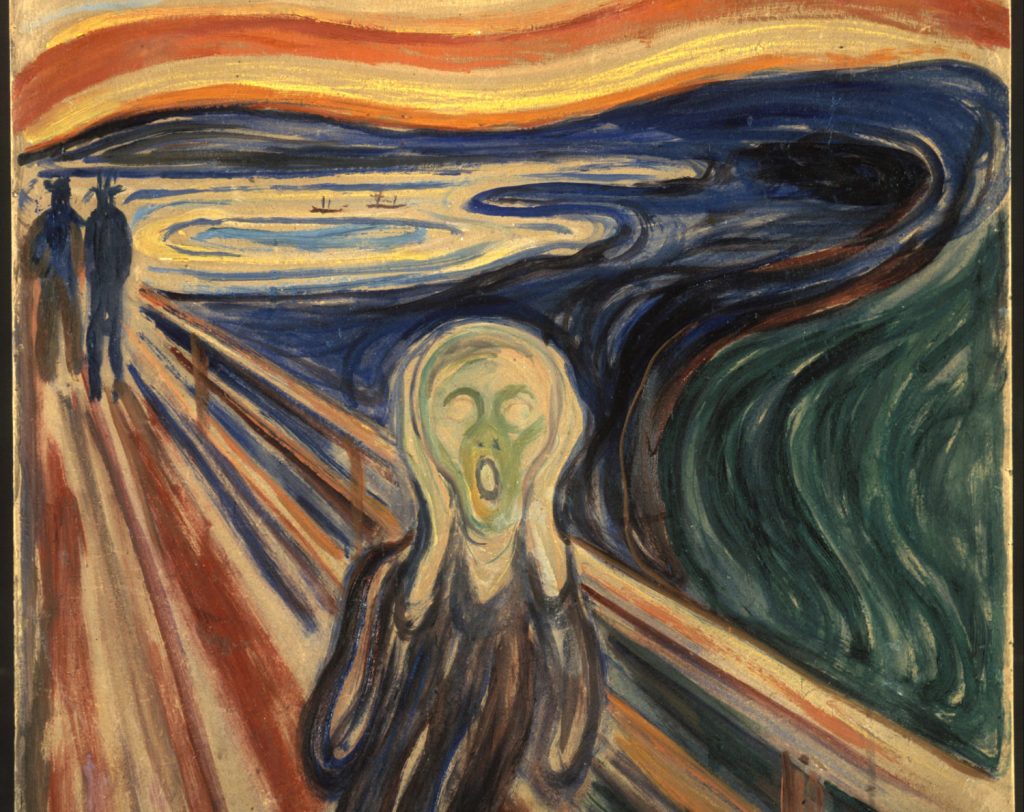
Descartes said Dubito, cogito, ergo sum. The words mean: I doubt, I think, therefore I am. Who of us has not at one time or another said to ourselves “I want to stop thinking!” To stop the thoughts and have some peace!
I want to share some of the thoughts that have filled my mind during this past year, some that were scary and painful, some that were reflective and soothing. I want to share these thoughts and feelings, not because I have any answers or any pretensions to answers, but simply because by sharing them I give voice to them, and by giving voice to them someone might hear me.
You don’t just wake up one day and feel overcome by emotions, feel that you don’t know anything, feel that there is nothing right in the world; these thoughts and feelings have origins that may go back a while. For me, one of those seeds of disorientation was, I believe, when listening to the news one evening I heard a woman say “we choose alternate facts.” My consciousness did a double take “alternate facts?” What does that mean?
Another seed was when many, many years ago as a young woman I got a phone call from a magazine asking if I wanted to participate in an investigative article they wanted to write about prejudice against black people in Sweden. I said yes, and a young man from South Africa and I went about Stockholm, eating in fancy restaurants and cafes, pretending we were married or just boyfriend/girlfriend, looking for apartments, shopping for babythings, and so on. We had a journalist and a photographer following us asking questions of the people we interacted with. The worst thing that happened was that once when we were waiting for a tram in Stockholm, a group of kids came up and looked and looked at us and then one of them got up enough courage and asked if he could touch Charles -he said yes and the young boy touched his forearm and then looked at his fingers… The article concluded that there was no prejudice in Sweden, just curiosity.
The year 2020 began well in our personal lives; my son who is a private pilot flew us to Sedona where we had a great layover with our grand children in the redrock country, then onto the Grand Canyon. We stayed at the El Tovar Hotel and enjoyed old fashioned luxury and comfort in a most beautiful setting. The Grand Canyon is more than a beautiful spot on earth, it is nourishment for the spirit, you drink in the canyon in big gulps and feel your soul expand and realize what a tiny ant you are in the grand scheme of things.
Then reality began to hit us; there had been whispers, some shouts, but they had quickly been quelled as not belonging in our reality, did not fit the official version of our society. For some reason though, this virus would not disappear, in spite of all the assurances. Then one day in March we were told to stay at home, not mix with each other, not go to work, schools closed and our world began to shrink and shrink and quickly became a microcosm of itself.
At first it was more of a nuisance than a threat on our lives. It was an inconvenience to not be able to travel, to not do the errands one normally did, not to go out for a meal. The worst was, of course, not to hug family, not to be with my grand children and have the same intimacy with them.
Quickly reality sank in, and we watched in horror how New York lived through a nightmare, and the fast spread of the virus across the country, and then it was in San Francisco and then closer and closer to home. My mind kept hearing “elderly, vulnerable, older people, over 65, at risk …” and for the first time in my life I began to feel as if I belonged to a certain class of people – in this case “the elderly”.
The isolation from others, from physically being present in the same room felt a deprivation, a loss of palpable connections, and began to wear on me. I felt myself becoming numb to the world around me, and I felt old and useless.
“Alice asked the Cheshire Cat, who was sitting in a tree, “What road do I take?” The cat asked, “Where do you want to go?” “I don’t know,” Alice answered. “Then,” said the cat, “it really doesn’t matter, does it?” – Lewis Carrol: Alice in Wonderland.
Their conversation sums up how I felt – I had no idea where I wanted to go.
In the midst of this feeling of powerlessness and depression, I started thinking about a movie we (my husband and I) had watched -cannot remember the title- but it was set in Africa, in Kenya in fact, and was about a young white English girl who fell in love with her African tutor. The time was just before and during the Mau Mau uprising. The movie gave a different perspective on the uprising, one which I had never learned during all my years in England, and one which narrated a case for justice, for equality, for dignity . The Mau Mau movement eventually led to Kenya’s Independence from Britain. The movie turned my thoughts to Thomas’ and my visit to Kenya. How much we enjoyed the country and its people, and of how proud the Kenyans are of their country. They were never shy of extolling its virtues, and I loved that about them. It’s still a very very poor country where most people live in what we would consider squalor, but, and a very important but, they have put education first. You see signs for schools everywhere, even out in the middle of the bush there will be a tattered sign proudly announcing a school!
I once remarked to our guide that there were a lot of East Indian people and business names everywhere. He explained to me that when the British left Kenya their servants they had brought from India, stayed and did not go back to India or with them to England. They made a life in Kenya and embraced Independence with the rest of the people. In 2017 the Asian people living in Kenya who were now citizens of Kenya were designated the 44thtribe of Kenya to show that they belong there as much as any indigenous tribe.
This, to me, was both moving and significant. Moving because Kenya was able to see these immigrants, often having come there without without choice, as one of them and extending their official recognition of this. Significant because it was an inclusive gesture, and one which gives privilege as well as obligation and would ensure they are all on the same footing, that they are not a separate class.
This led me to another thought. The horrific violence in Rwanda towards the Tutsis in particular, the genocide that occurred in 1994 and no country in the world raised a hand to stop it or intervene. It was so brutal and so directed it boggles the mind, and one feels just despair. A couple of years afterwards I saw a documentary about violence and its destructive qualities. Some Tutsi Rwandan women were interviewed and were asked about their experiences during the genocide. They had all lost family members, husbands, sons, daughters, parents, and most of them had been brutally violated and/or beaten.
What shocked me, and made me feel very humble was what those women said. They said that they had to help the families of the people who had perpetrated the violence and killing. They had to help the wives of the men who were now in prison for killing their families, they had to help the children of their persecutors have an education, have food and shelter. The Tutsi women had to reach out their hands to bridge the divide, otherwise the violence would not stop, and their own children could never feel safe. I cried when I listened and felt so small knowing that I would most likely not have the strength to do so.
The thoughts about the Asian community becoming the 44th tribe in Kenya and the incredible strength and power of the women of Rwanda lifted me up and I realized that again that being inclusive is always powerful, is always going to be stronger because it unites people, it makes them share a common goal. And, perhaps our country could learn that inclusiveness is, like love, much more powerful than exclusion.
We ambled along in our lives being told one thing about the pandemic by our leader and another by the scientists, making our own judgements and decisions, and becoming a little cynical about taking trips in the late summer, or travelling abroad in the autumn.
Then that awful day in May came. May 25, 2020 punched me in the face, trampled on everything I thought I knew. I saw a man being murdered right in front of my eyes. I saw the murderer kill a man with complete callousness. The police officer never questioned, or gave a thought to what he was doing. That knee on another man’s neck, squeezing the life out of him, chilled my soul.
George Floyd’s murder and the Black Lives Matter movement made me think about my own part in all this. What was my responsibility in his death? Why did I feel so guilty so much of the time? What could I actually do to change anything? To make things better?
The following weeks, and months were some of the saddest and most conflicted of my life. Watching the demonstrations, listening to people, reading articles and discussions, hearing the news was like being hit by an avalanche of information, thoughts, ideas and ideals, broken promises, acts of cowardice, of injustice, of valour, of strength.
I felt so guilty so much of the time, guilty for not having been part of any movement to change things for black people, guilty for having a good life while so many black people had nothing, simply guilty for being alive. I told myself that rationally I had nothing to be guilty about. I had never practiced racism or prejudice. But – I was white. Gradually I began to grasp what being born white actually means. I finally understood what Black Lives Matter means.
As I watched what was happening, the demonstrations, the pleas for justice, and learned about the history of black people in America, a feeling of utter helplessness came over me. Of powerlessness – what could I actually do to change things? My voice had no impact or power to change anything. I was totally unimportant, and to myself I also carried blame because I had not “seen”, I had not truly understood the society I lived in, and by my silence and ignorance, I had furthered the injustices and cruelty.
It did not matter that I believed in social justice, in equality for all men, in the integrity and dignity of the individual. Those beliefs counted for nothing because I had never taken any opportunity to voice them, I had never understood that it is not enough to just believe, one has to understand why one believes.
I tried to talk about this with a friend whom I trusted. She and I had formed a bond, and had traversed Spain and France together for 3 weeks the year before. We had shared a lot of intimate thoughts. Since I felt the need to discuss my anguish at what had happened and my feeling of powerlessness and inadequacy with someone, I trusted her to hear me, and to help me.
To my utter horror when I raised the subject of George Floyd’s murder and the Black Lives Matter movement, she replied by saying “All lives matter.” When I tried to explain how I felt and that I had a need to talk about this, her reply was that she “helped poor families one at a time,” and “she refused to talk politics.” She then got up and left my house. Later she sent me an email in which she told me that I needed to be a kinder person and gave advice on how to become a kinder person, and that she hoped we could still be “empathetic” friends.
For me, this was a rift that could not be bridged. I felt not only that I had lost what I had thought of as a real friend, but also that I had been betrayed. I quickly realized that there was no betrayal, I had deceived myself about our relationship. She is a good person and I wish her well.
The virus raged on, and the death toll kept rising, hospitals were overloaded and nurses and doctors begged people to wear masks. The fact that our leaders had kept secret the real dangers of the virus, and not prepared for it, just added another layer of powerlessness to my daily life. I kept telling myself that we were fortunate, that we were OK, did not lack for anything, and our routine, since we were both now retired, was still the same pretty much. It did not help, I still felt deprived and depressed.
I kept hearing the phrases: “elderly, vulnerable, older population, fragile persons” and heard and saw the huge numbers people over 65 falling victims to the virus. We, the elderly, had to be treated with caution, treated as a separate group, and yes, isolate more. Logically, I knew this to be true and that it was in order to preserve our lives, but emotionally it took its toll. I felt set apart, and weak, and vulnerable, and more useless. And, I mourned the loss of our way of life – the loss of being able to meet up with friends and family, the loss of our freedom to move around in our daily life.
I fell deeper into depression, and I wondered often “what’s the point?” “I have had a great life and now I am old and I should not be greedy for more.” I had no goal, no objective, no excitement, no new challenge to look forward to. I remembered the days when I would wake up in the mornings and be eager to go to work, to meet my customers, my books, investigate and solve mysteries about books and their owners, look forward to visiting places and people but now – there was nothing to wake up for.
By chance I came upon an article about depression and psychological distress by Michele DeMarco who has worked extensively in the field. In it she said:
Powerlessness is at the heart of moral distress. It is the feeling that we have had to, or must seriously, compromise ourselves or something we hold dear due to external forces seemingly beyond our control. It is also the sense that others don’t grasp a moral significance or moral imperative that is clear to us. Moral distress is what results from repeatedly not having our values respected, either individually or collectively.
Finally, something broke through, and I realized that I had to do something about being so depressed and lethargic. For me, doing something is to trying to understand, to make some sense, to find some logic – then I could perhaps accept what was happening. I continued to read. Someone whose work I respect is the American political philosopherJohn Rawls who said in his Theory of Justice: “We do not deserve our place in the distribution of native endowments, any more than we deserve our initial starting point in society. That we deserve the superior character that enables us to make the effort to cultivate our abilities is also problematic; for such character depends in good part upon fortunate family and social circumstances in early life for which we can claim no credit. The notion of desert does not apply here.”
Rawls also stated a truth we sometimes forget “The way things are does not determine the way they ought to be.” And further “ … the natural distribution is neither just nor unjust; nor is it unjust that persons are born into society at some particular position. These are simple natural facts. What is just and unjust is the way that institutions deal with these facts.” He proposes that we deal with these facts by agreeing to “share one another’s fate,” and “to avail [ourselves] of the accidents of nature and social circumstance only when doing so is for the common benefit.”
What he is saying is that I could not claim any credit for having been born into an affluent, white family in a stable society. That my good fortune in my life was due in largest part to no effort of my own – it was due to who my family was when I was born, but that circumstance just is, therefore I am not guilty of anything. But he is also saying, that I should use my “wealth” for the common good, because through no fault or credit of my own I have received more than my share.
It may seem strange, but this helped me to deal with my feelings of guilt and I could move on. I tried to think of what I could actually do. What was slowly becoming clear to me was that to change society and the attitude of society is a long process. I. had thought in my naivite when almost sixty years ago I had taken part in that investigative article in Sweden, that all was well in the world. It was curiosity, not prejudice. I had thought that what happened in South Africa had been put to rights when Nelson Mandela became President and apartheid was abolished. I had thought that the US had changed with the passing of the Civil Rights Act.
Society is like one of the huge cargo vessels sailing on the sea, it takes forever for it to change course. To change society takes generations, generations of educated and enlightened people. Education at school- but perhaps more importantly, discussion amongst all people. Discussions to understand each other, to grasp the real issues, discussions of how to achieve true equality between races. To find common language first so we could be sure we talk about the same issues. Words matter.
I not only was reading more, but began to engage in conversations and discussions online. My thinking was simple, if people could talk with each other and discuss in depth issues such as race, prejudice, fear, some people would learn how others saw those issues, they might realize that depending on where you come from, ie your background and upbringing, you might see the same issue very differently. That people not necessarily choose to be prejudiced but have absorbed a certain view of people, events and places.
I re-read Dr. Martin Luther King’s Letters from Birmingham Jail. He wrote them to the clergy while imprisoned in Birmingham Alabama in 1963 and in them he said:
“I must confess that over the past few years I have been gravely disappointed with the white moderate. I have almost reached the regrettable conclusion that the Negro’s great stumbling block in his stride toward freedom is not the White Citizen’s Councilor or the Ku Klux Klanner, but the white moderate, who is more devoted to ‘order’ than to Justice; who prefers a negative peace which is the absence of tension to a positive peace which is the presence of Justice; who constantly says ‘I agree with you in the goal you seek, but I cannot agree with your methods of direct action.’ “
I then went back to Frederick Douglass and read what he had written about 100 years earlier. One of the things he said was simply: What I ask for the Negro is not benevolence, not pity, not sympathy, but simply justice.
One thing that became clear to me about Black Lives Matter was that most of the laws were in place, it is the enforcement and interpretation of the laws that fail. Why do they fail? Because of the attitudes, or views of the different parties: the judges, policeman, the prosecutor, the Senator, the neighbour, the co-worker, the teacher and so on. Thus, it comes back to changing those attitudes and views. How do we do this? By education and by discussing the issues.
So, I had come back to the beginning. But not quite because I felt much more hopeful. I realized that there were an awful lot of people talking with each other, especially of the younger generations. And, their lenses had shades of gray. They were educating each other, learning from each other, seeing different view points through each other. The words of Nelson Mandela rang so true: “Education is the most powerful weapon which you can use to change the world.”
Nelson Mandela also said “No one is born hating another person because of the color of his skin, or his background, or his religion. People must learn to hate, and if they can learn to hate, they can be taught to love, for love comes more naturally to the human heart than its opposite.”
When I reflected on what these great men said, and the truth of what they said I was awed and asked myself again “what can I actually do?” I am not a brave person, I saw the 75 year old man who was brutally shoved by a policeman at a peaceful demonstration and I was afraid of it happening to me, and I am afraid of being infected by the virus, so to participate in demonstrations is not an option. I did make a poster of a Black hand and a white hand holding each other and the caption “Silence is not an option” and I put it up on our garage door. When I was putting it up, I confess I was nervous. I was making a public statement, albeit in my little community, for the first time. I fully expected to have rotten eggs thrown, or someone tear it down, but to my surprise it is still up.
I also came across some writing by Mahatma Ghandi, the father of the non-violent protest. He had said: “It’s the action, not the fruit of the action, that’s important. You have to do the right thing. It may not be in your power, may not be in your time, that there’ll be any fruit. But that doesn’t mean you stop doing the right thing. You may never know what results come from your action. But if you do nothing, there will be no result.”
His words helped me to shake that depressing feeling of being useless and without any power. My age does not make me impotent, my bodies’s cells at this age may make me more susceptible to the virus, but my age in no way prevents me from thinking and acting. I shed my fear of being labelled “elderly, older generation, vulnerable.”
On my own I am powerless, on my own I cannot change anything but my own life. But, if I speak up, if I engage in discussion with others, if I denounce what I believe is wrong at every opportunity, and I try to understand how others think and believe and we exchange views, I do believe that one day men and women will not be judged by the colour of their skin but will be judged by the content their character.
My journey in my mind is not ended, but at the moment I am in a much better place and I have the energy and will to spend time with my grand daughters, and to create opportunities for them to explore their thoughts, their feelings, and their views of their world. I hope to help them see their world in not only all the shades of gray but also of compassion and empathy, of humility and most of all of love.
I want to close with some lines from the poem The Hill We Climb by Amanda Gorman. She is so young but so wise and so brave, and her words give me hope, strength and love.
When day comes, we step out of the shade of flame and unafraid.
The new dawn balloons as we free it.
For there is always light, if only we’re brave enough to see it.
If only we’re brave enough to be it.